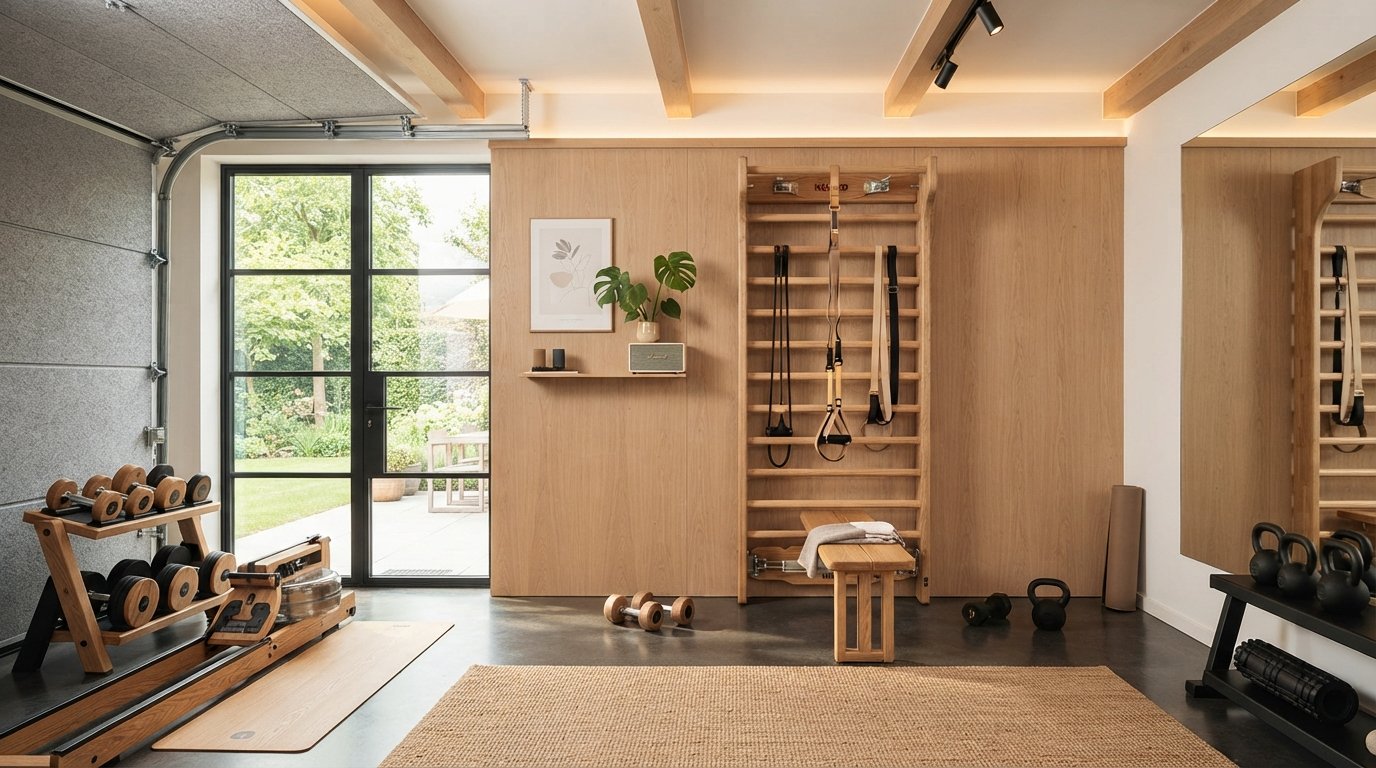
Building a massive, aesthetic physique inside a two-car garage requires a completely different mindset than training at a commercial gym.
You don’t have five different angles of cable crossovers. You don’t have a $5,000 hack squat machine. When you strip away the luxury of endless equipment, you are left with cold iron, gravity, and your own work ethic.
But here is the brutally honest truth: you don’t need fancy machines to build maximum hypertrophy. In fact, the constraints of a garage gym can actually force you to train better.
If you want to pack on serious muscle mass without stepping foot in a commercial gym, you must strictly follow these five non-negotiable rules of garage gym programming.
1. Master the “Big Four” Variations
When your primary tools are a barbell, a power rack, and some plates, your programming must revolve around compound movements. The “Big Four” (Squat, Bench Press, Deadlift, and Overhead Press) are your bread and butter.
However, doing the exact same lift every week leads to plateaus and overuse injuries. To maximize hypertrophy, you must rotate variations:
- Squat: Alternate between High-Bar Back Squats, Front Squats, and Bulgarian Split Squats (using dumbbells or a barbell).
- Bench: Rotate Flat Bench, Incline Bench, and Close-Grip Bench to target different heads of the chest and triceps.
- Deadlift: Mix Conventional, Sumo, and Romanian Deadlifts (RDLs) to build a bulletproof posterior chain.
2. Embrace Tempo and Pause Reps (The Weight Constraint Hack)
In a commercial gym, if an exercise gets easy, you just move the pin down the weight stack. In a garage gym, you might literally run out of plates, or you might not have the heavy dumbbells required to progressively overload traditional sets.
The solution? Manipulate time under tension.
If you only have up to 50lb dumbbells, a standard goblet squat might be too easy for 10 reps. Instead, try a 3-2-1-0 tempo: take 3 seconds to lower the weight, pause for 2 full seconds at the absolute bottom (killing the stretch reflex), and explode up in 1 second.
By utilizing pauses and slow eccentrics, you can make 135 lbs feel like 315 lbs, triggering massive muscle growth without needing to buy hundreds of pounds of extra iron.
3. Density Over Empty Volume
Hypertrophy is driven by three main factors: mechanical tension, muscle damage, and metabolic stress. When you lack machines, the easiest one to manipulate is metabolic stress.
Instead of just doing 3 sets of 10 and resting for three minutes while scrolling on your phone, increase your training density (the amount of work done in a specific timeframe).
- EMOMs (Every Minute On the Minute): Pick a weight you can lift for 10 reps. Do 5 reps at the top of every minute for 10 minutes.
- Rest-Pause Sets: Take a set to failure, rest exactly 15 seconds, and immediately crank out as many more reps as possible.
This forces blood into the muscle (the “pump”) and causes the metabolic stress necessary to signal growth.
4. Pull Twice as Much as You Push
The biggest trap of the garage gym athlete is developing a massive chest and front delts, while the back remains completely flat. Why? Because pushing (Bench Press, Overhead Press) is easy to set up in a rack. Pulling requires a bit more effort.
To avoid looking like a hunchback and to build a thick, wide physique, you must institute the 2:1 Ratio: for every pushing movement you do, you must do two pulling movements.
If you bench press, you must follow it up with Barbell Rows and Pull-ups. If you overhead press, you must hit Dumbbell Rows and Band Pull-aparts. A thick back not only looks imposing, but it creates a stable shelf for your heavy bench and squats.
5. Eat Like You Mean It
You can have the most perfectly optimized, science-based garage gym routine in the world. You can grind through brutal sets of paused squats until your legs shake. But if you aren’t eating in a caloric surplus, you will not grow.
Muscle cannot be created out of thin air. You must consume more calories than you burn, and you must eat enough protein (roughly 0.8g to 1g per pound of body weight) to rebuild the tissue you tore down in the garage.
Don’t let the isolation of the garage gym fool you into training like a beast but eating like a bird. Track your macros, prioritize sleep, and fuel the machine.
The Bottom Line: Your garage gym is not a disadvantage. It is a hyper-focused environment free of distractions. Apply these five rules consistently for six months, and you will outgrow anyone wasting their time on the elliptical at the commercial gym down the street.