When you finally decide to ditch the commercial gym and build your own training sanctuary, one of the first major purchasing decisions you will face is how to handle dumbbells.
Dumbbells are arguably the most versatile piece of equipment you can own, allowing for unilateral training, hypertrophy work, and stabilization. But should you drop thousands of dollars on a massive rack of traditional fixed hex dumbbells, or save the space and buy a single pair of high-tech adjustables?
Here is the definitive breakdown to help you make the smartest choice for your space, budget, and training style.
The Case for Adjustable Dumbbells
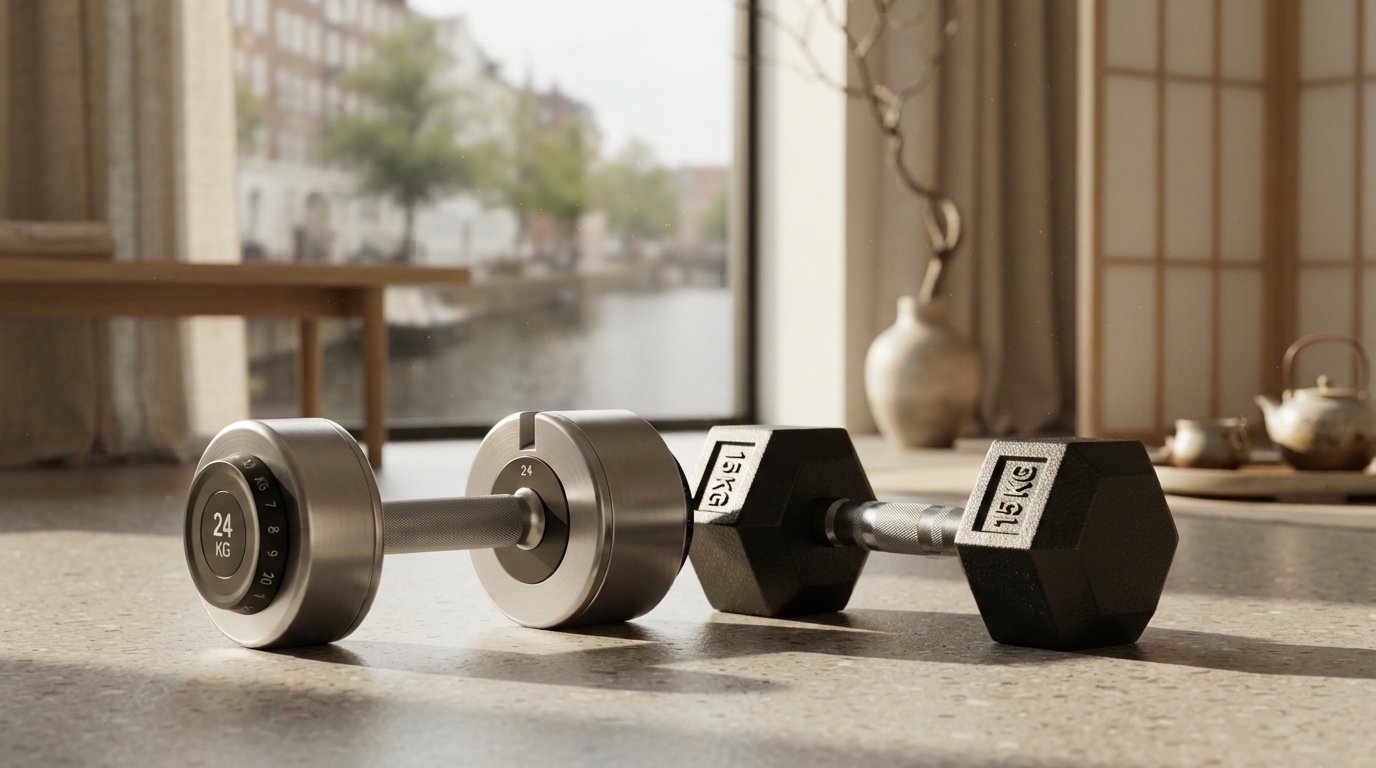
Adjustable dumbbells (like Nuobells, Bowflex SelectTech, or PowerBlocks) have exploded in popularity over the last decade, and for good reason. They allow you to select a weight—typically ranging from 5 lbs to 80 lbs—with the twist of a dial or the pull of a pin.
The Pros:
- Unbeatable Space Efficiency: A full rack of fixed dumbbells (5 lbs to 50 lbs) takes up an entire wall in your garage. A pair of adjustables takes up less than two square feet. If you are training in a spare bedroom or a crowded one-car garage, this is the ultimate space-saving hack.
- Cost Effective: A high-quality pair of adjustable dumbbells usually costs between $350 and $700. Buying that exact same weight range in individual fixed cast-iron pairs will easily cost you over $1,500.
- Micro-Loading: Many adjustables allow you to increase the weight by 2.5 lb increments, which is incredible for progressive overload on smaller muscle groups like the lateral deltoids.
The Cons:
- Durability Concerns: Adjustable dumbbells are packed with gears, dials, and plastic selector pins. If you drop them heavily after a grueling set of bench presses, they can—and will—break.
- The “Clunky” Feel: Because they are designed to house multiple plates, they are often longer and bulkier than fixed weights, which can feel awkward during certain movements like bicep curls or goblet squats.
The Case for Fixed Weights (Hex Dumbbells)
Walk into any commercial gym in the world, and you will see a rack of fixed weights. In the garage gym community, rubber-coated hex dumbbells are the gold standard for durability and performance.
The Pros:
- Indestructible: Traditional cast-iron or rubber-coated hex dumbbells have zero moving parts. You can drop them, throw them, and abuse them for decades, and they will never break.
- Instant Drop Sets: If you want to do a mechanical drop set (e.g., benching 50s, dropping them, and immediately grabbing 30s), fixed weights allow you to transition in less than two seconds. Adjustables require you to stop, re-rack, twist the dial on both handles, and pull them back out.
- Perfect Balance: Fixed weights are ergonomically balanced and perfectly sized for their specific weight, feeling entirely natural in your hand.
The Cons:
- The Price Tag: Buying a complete set (5 lbs to 100 lbs) is an enormous financial investment that can quickly consume your entire gym budget.
- Massive Footprint: A 5-50 lb set requires a 3-tier commercial rack, demanding a significant amount of permanent floor space.
The Final Verdict
Buy Adjustable Dumbbells if: You are working with limited floor space (like an apartment or a shared garage) and you want the absolute best “bang for your buck.” Just remember to treat them like a piece of technology—do not drop them!
Buy Fixed Weights if: You have a large, dedicated garage space, you have a higher budget, and your training style involves aggressive, heavy lifting where weights are occasionally dropped.
Disclaimer: We are not medical professionals or registered dietitians. The information provided is for educational purposes only. Always consult with a doctor before starting a new fitness routine or attempting heavy unilateral lifts.